ABC and VED: two questions every item should answer.
A planner cannot give thousands of items the same care. ABC and VED are the two labels that decide where attention, stock and money go. One is about value, the other about consequences, and you need both.
Why classify at all
Most companies plan every item with the same rule: the same safety stock logic, the same review rhythm, the same target. That feels fair, but it is expensive. Cheap, unimportant items get as much attention as the ones that carry the business, and the items that would stop a production line are protected no better than a box of cable ties.
Classification fixes that by sorting items into groups that deserve different treatment. Two labels do most of the work: ABC for value and VED for criticality.
ABC: how much money moves through the item
ABC ranks items by the value they move over a year: how much is used or sold, times what it costs. In almost every business a small group of items carries most of that value. Those are the A items. A larger group in the middle are B items, and the long tail of items that each move little money are C items.
ABC tells you where money and planning time pay off. A small improvement on an A item frees more cash than a big one on a C item. A items deserve close review, accurate forecasts and stock kept tight; C items deserve simple rules that take little time.
What ABC does not tell you
ABC is blind to consequences. A gasket that costs a few euros is a C item, but if it is missing, a pump stays down and a treatment plant runs on its backup. A slow-selling spare that nobody has needed for a year is a C item too, until the day it is needed.
Planning on ABC alone pushes these cheap, critical items towards lean stock, which is exactly the wrong way round. That is why the second label exists.
VED: what happens when the item is missing
VED sorts items by the consequence of running out:
- Vital: a shortage stops production, a customer delivery or a critical service. There is no workaround.
- Essential: a shortage hurts, with extra cost, delays or a temporary fix, but things keep running.
- Desirable: a shortage is an inconvenience. It can wait for the next delivery.
Use both: the nine combinations
Put the two labels together and every item lands in one of nine cells. Each cell asks for a different policy. Read the grid by row for criticality and by column for value:
| Criticality | A: high value | B: medium value | C: low value |
|---|---|---|---|
| Vital | Protect and watch closely. High service, reviewed often, suppliers managed actively. | Protect. High service, regular review. | Protect generously. The buffer is cheap; a shortage is not. |
| Essential | Keep tight and well forecast. Good service, frequent review. | The standard policy. Balanced service and stock. | Simple rules, a comfortable buffer. |
| Desirable | Keep lean. Money matters more than the occasional wait. | Lean, reviewed now and then. | Minimal attention. Order in bulk, or stop stocking it. |
Mistakes we see often
- Ranking on unit price instead of the value moved over a year. An expensive item that is almost never used is not automatically an A item.
- Classifying once and never again. Demand shifts, products age, and last year’s A item can be this year’s C item. The classes should follow the data.
- Calling everything Vital. When half the range is Vital, the label stops meaning anything. Vital should be the items without a workaround.
- Letting one label decide everything. Value and criticality are different questions; mixing them into one ranking hides the cheap, critical items.
How plnnd uses ABC and VED
In plnnd, every material at every location carries both labels, side by side. Value class follows from your own usage and cost data. Criticality follows from the item’s data too, and you can set it per item yourself, because only you know which items have no workaround; the app then shows it was set by a planner.
Each item has its own target service level, which safety stock is built on, so a cheap Vital part can be protected as it should be. The Materials list filters on either label in one click.
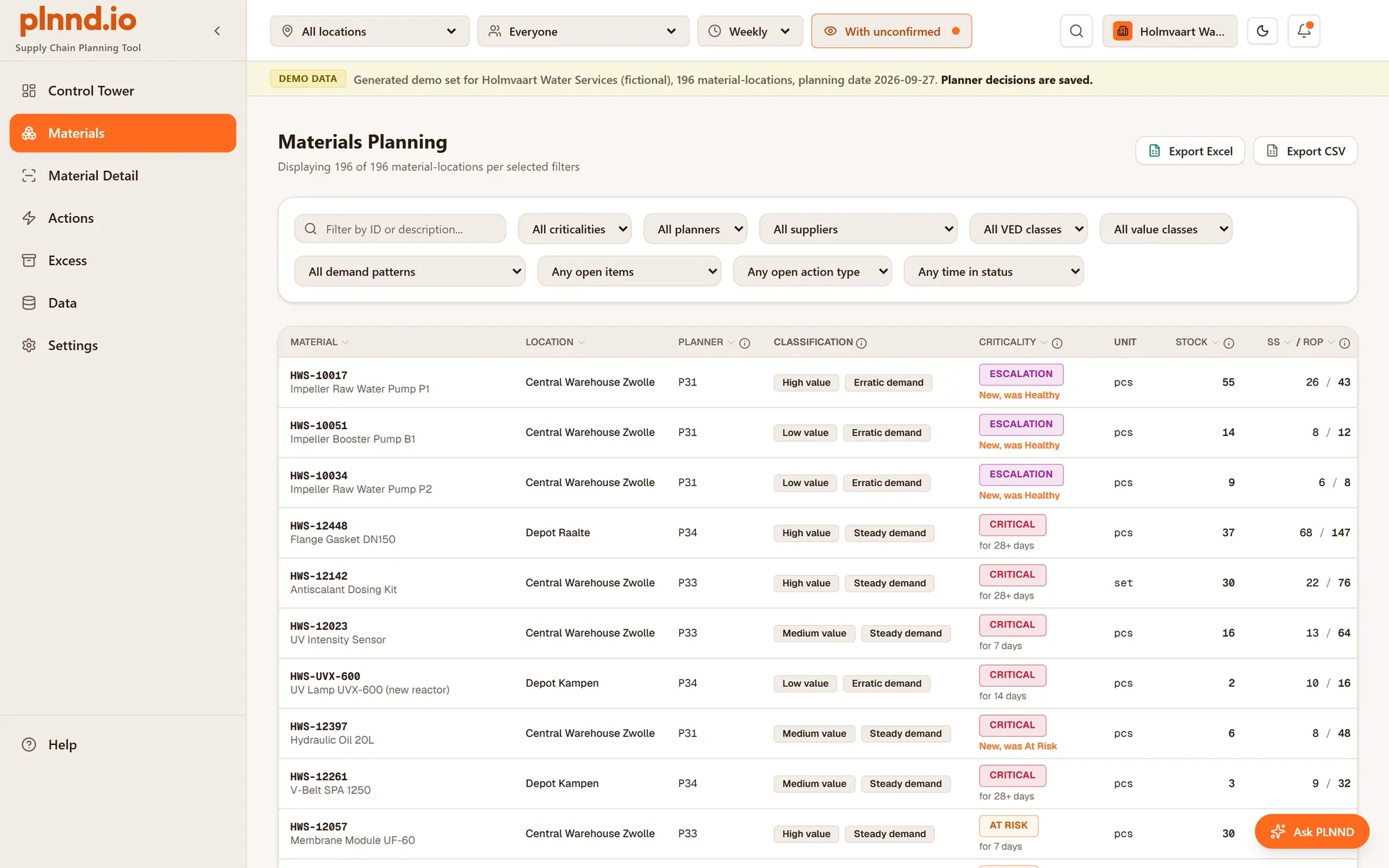
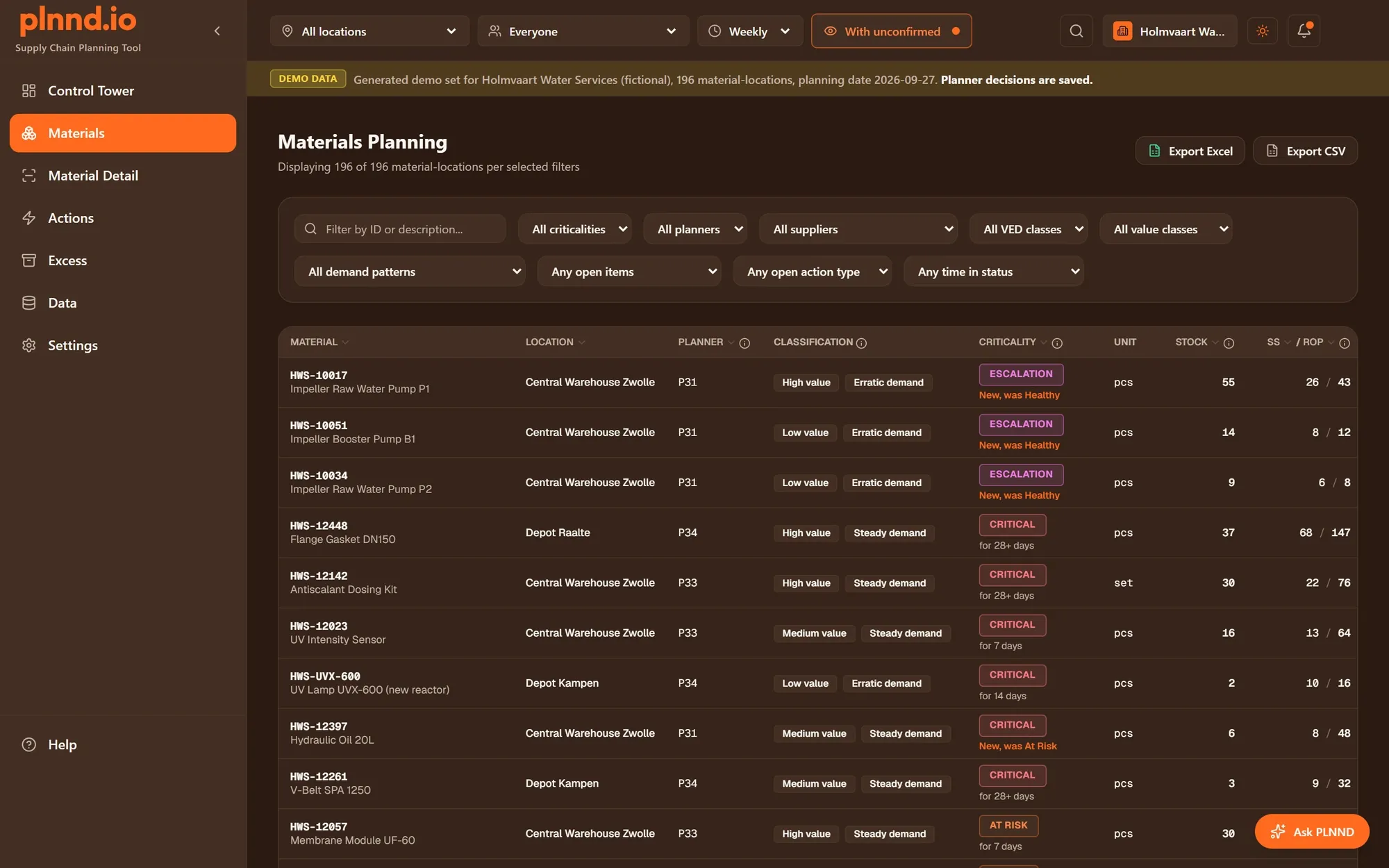
Materials list of the Holmvaart Water Services sample, a water utility’s spare parts.